


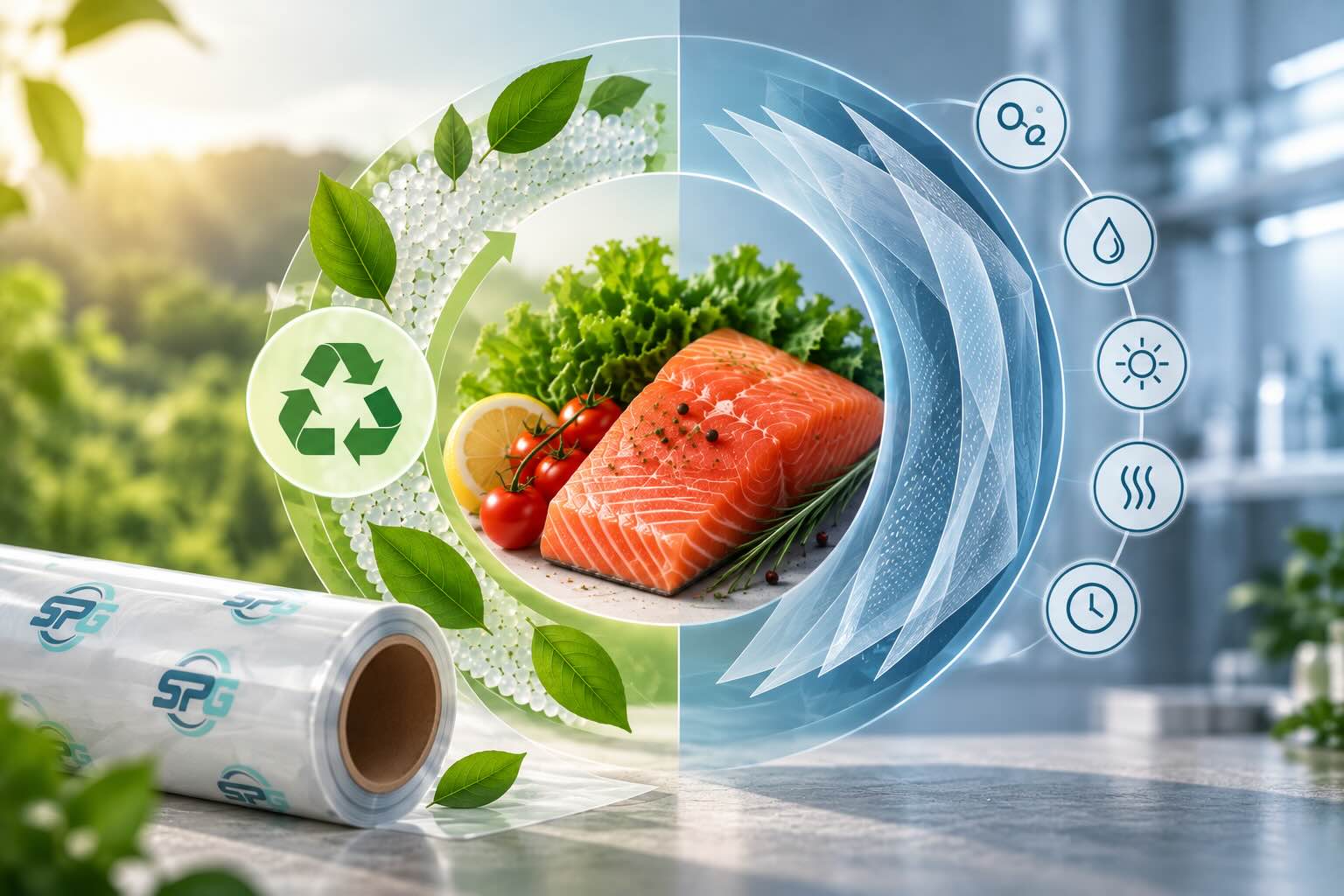
Creating sustainable food packaging is not simply about using less material or making packaging easier to recycle. Packaging must also protect food and preserve it properly throughout its shelf life.
The challenge is to improve recyclability without removing the properties the food needs for adequate protection. A more recyclable structure is only a better solution if it can still deliver the required shelf life.
What is sustainable packaging in the food industry?
Sustainable food packaging aims to reduce its environmental impact while still protecting and preserving the product for the intended period. Sustainability must therefore be assessed alongside packaging performance.
What makes packaging sustainable?
When we talk about sustainable packaging, we should not focus solely on the material used. We can also address different aspects of its design, such as:
- Reducing thickness and using less material.
- Simplifying the structure where technically feasible.
- Improving its recyclability.
- Incorporating recycled material where possible and permitted.
However, these improvements must maintain the properties required by the food product. Reducing material serves little purpose if it increases the risk of deterioration or unnecessarily shortens the product’s shelf life.
What is expected of sustainable food packaging today?
In addition to reducing its environmental impact, packaging must protect the product, preserve its properties, provide sufficient strength, and perform correctly during packaging, transport, and storage.
Requirements vary by food product. A dry product does not require the same level of protection as meat, cheese or fresh food. That is why sustainable design must always begin with the product’s actual requirements.
What is shelf life and why is it critical in food packaging?
Shelf life is the period during which a food product maintains the established levels of safety and quality when stored under the specified conditions.
Packaging helps achieve this shelf life by protecting the food from external factors that can accelerate deterioration. Depending on the product, it must primarily control:
- Oxygen, to limit oxidation processes.
- Moisture, preventing losses or gains that could affect texture and quality.
- Light, when exposure may cause changes in sensitive foods.
- Aromas, helping to preserve the product’s organoleptic properties.
Depending on the application, parameters such as oxygen transmission rate (OTR) and water vapour transmission rate (WVTR) help determine the level of barrier protection required.
This is why the required barrier properties differ across food products.
Shelf life and packaging: how the shelf life of packaged food is determined
When we talk about shelf life in packaging, shelf life does not depend exclusively on the material. To determine the shelf life of a packaged food product, the following factors must be considered together:
- The characteristics and composition of the food product.
- The production and packaging process used.
- The barrier properties of the packaging material.
- The temperature and storage conditions.
- The expected duration and conditions of distribution and sale.
Based on these factors, the appropriate packaging is selected, and shelf-life studies verify that the food maintains the established safety and quality parameters throughout the intended period.
How design for recyclability can affect shelf life
One strategy to improve recyclability is to simplify packaging composition. However, each material or layer may perform a specific function, so removing components without assessing their performance can affect product preservation.
What happens when packaging is simplified to make it more recyclable?
In multilayer packaging, each component may perform a different function: providing strength, facilitating sealing, or providing barrier properties.
Simplifying the packaging therefore does not simply mean removing layers. We must first analyze each layer’s role and determine whether a simpler structure can deliver the same performance.
The aim is to use only the necessary materials, avoiding both over-engineered structures and reductions that could compromise packaging performance.
How simplifying structures can affect barrier properties
Changing the structure can alter its ability to control the transmission of oxygen, water vapor, or light, factors that affect each food product differently.
For example:
- A food product sensitive to oxidation will require particular control over oxygen transmission.
- A product whose texture depends on its moisture content will require an appropriate water vapor barrier.
- Certain foods that are sensitive to light may require specific protection against it.
Any change must therefore be validated to ensure the new structure maintains the barrier properties the product requires throughout its shelf life.
How to design sustainable packaging without compromising preservation
The starting point should not be the packaging material, but the product and the performance it requires. Once the necessary barrier, mechanical and sealing properties have been established, the structure can be optimised to reduce material or improve recyclability.
To achieve this, we analyze:
- Barrier requirements.
- Packaging strength.
- The sealing and packaging process.
- Transport and storage conditions.
- The shelf life the product needs to achieve.
Mono-material and high barrier: how far can optimization go?
Mono-material solutions can improve recyclability by using mainly materials from the same polymer family. Today, recyclable structures are available that can provide high-barrier properties for certain applications. SP Group has developed solutions such as PE HB ECO, which combine recyclability with barrier properties against oxygen, water vapor, light, and aromas.
However, not all food products have the same requirements. Mono-material packaging should therefore be used when it can maintain the necessary performance, rather than being regarded as a suitable solution for every product.
When recyclability does not compromise shelf life
Recyclability and preservation can be compatible when a simpler structure still provides the necessary protection.
The key is to validate the new packaging under real-world conditions. If it maintains performance and achieves the intended shelf life, recyclability can improve without compromising the preservation or quality of the packaged food.
What does the PPWR say about this balance?
The European Packaging and Packaging Waste Regulation (PPWR) has been in force since August 2026 and sets requirements to move towards more recyclable packaging while reducing its weight and volume.
However, these reductions must be compatible with the packaging’s functionality. In the food sector, this means that design for recycling must maintain product protection, safety and preservation.
The PPWR therefore reinforces a key industry challenge: reducing packaging’s environmental impact without compromising the functions required to preserve food products.
How SP Group helps find the right balance between sustainability and preservation
At SP Group, packaging optimisation starts with the product, not with a predefined material. We assess the required barrier properties, packaging process, sealing conditions, mechanical performance, distribution environment and intended shelf life before defining the most appropriate structure.
We analyze barrier requirements, format, sealing, and distribution conditions to determine how the structure can be optimized or its recyclability improved without compromising product preservation.
The aim is to identify the structure that provides the required performance while using materials as efficiently as possible.
Looking to improve the recyclability of your food packaging without compromising shelf life?
Talk to our team. We can assess your product, barrier requirements and packaging process to identify opportunities to optimise the structure while maintaining the required performance.