


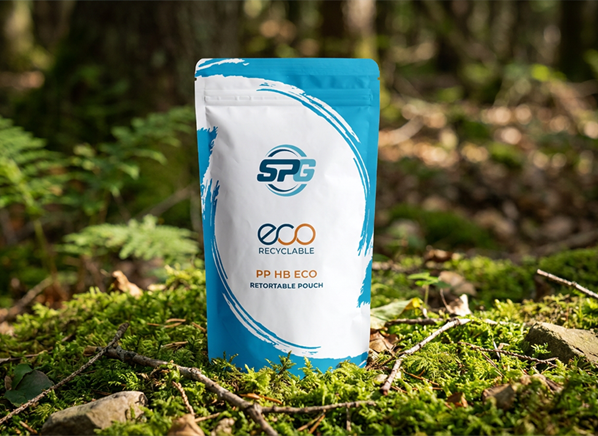
The transition to a circular economy is driving new approaches to food packaging design. In this context, mono-material packaging has emerged as a key solution for improving recyclability without compromising food protection or packaging process efficiency. However, designing a mono-material package requires selecting the right raw materials, optimizing its structure, and tailoring it to the specific requirements of each application.
In this article, you’ll learn what mono-material packaging is, its main advantages and technical challenges, and how it can support compliance with the progressive recyclability requirements introduced by the PPWR.
What is mono-material packaging and why is it gaining importance?
Mono-material packaging is packaging made primarily from a single type of polymer. Unlike multi-material structures that combine different materials, this design makes sorting and recycling at the end of the product’s life much easier, as it eliminates the need to separate incompatible layers.
However, mono-material does not automatically mean recyclable. Inks, adhesives, coatings, barriers, closures and other components must also be considered, together with the collection, sorting and recycling infrastructure available in the target market.
The growing interest in mono-material packaging is driven by several factors:
- It improves recyclability within current waste management systems.
- It helps companies meet the objectives established by the PPWR.
- It supports the transition to a circular economy.
- It promotes eco-design from the earliest stages of product development.
- It reduces the complexity of certain recycling streams.
However, choosing a mono-material solution is not simply a matter of replacing a multi-layer structure. Every project must consider the product’s specific requirements, the packaging process, and logistics to ensure the packaging maintains the necessary performance throughout its entire lifecycle.
What does the PPWR mean for mono-material packaging?
The PPWR has applied generally since 12 August 2026 and establishes that packaging placed on the EU market must be recyclable. Its requirements will become progressively more detailed: design-for-recycling performance grades will apply from 2030, while recyclability-at-scale will be incorporated from 2035, according to the regulatory timetable.
Mono-material design can help packaging meet these objectives, but it is not, by itself, proof of compliance. Each complete packaging unit will need to be assessed against the applicable criteria.
What is the difference between mono-material and multi-layer packaging?
The main difference lies in their composition. Multi-layer packaging combines different materials to deliver properties such as strength, oxygen and moisture barrier performance, and reliable sealing. By contrast, mono-material packaging uses a single polymer family and achieves these properties through careful design and advanced manufacturing processes.
The main differences are:
- Mono-material packaging is easier to recycle.
- Multi-layer packaging can more easily provide high-barrier performance.
- Mono-material packaging requires a more optimized design to maintain packaging performance.
- Mono-material structures support compliance with the PPWR’s new recyclability requirements.
The right choice will always depend on the food product, its required shelf life, and the specific demands of the packaging process.

Why does mono-material packaging support a circular economy?
The goal of mono-material packaging is not simply to create packaging that is technically designed for recycling, but to consider its entire lifecycle from the beginning. When packaging can be collected, sorted and recycled through the available infrastructure, its materials have a greater opportunity to remain in circulation.
Achieving this requires focusing on several key aspects:
- Selecting structures that are compatible with existing recycling systems.
- Reducing unnecessary components that make packaging recovery more difficult.
- Optimizing material thickness through eco-design strategies.
- Designing packaging that complies with PPWR requirements.
- Maintaining food protection throughout the product’s entire shelf life.
Circularity depends not only on the type of plastic used, but also on the overall packaging design and how it integrates with the entire recycling value chain.
The most widely used mono-materials in the food industry
There is no single mono-material solution suitable for every application. The right choice depends on the type of food, filling conditions, preservation process, and packaging system.
PP mono-material and other common solutions
PP mono-material packaging is one of the most widely used options thanks to its excellent balance of strength, sealability, and moisture resistance. In addition to polypropylene, other commonly used polymer families include:
- Polyethylene (PE).
- High-density polyethylene (HDPE).
- Low-density polyethylene (LDPE).
- Combinations within the same polymer family that preserve recyclability.
Each material offers different characteristics in terms of flexibility, transparency, rigidity, and heat resistance.
Plastic mono-materials for different packaging applications
Plastic mono-material packaging can be adapted to a wide range of food packaging formats, including:
- Flexible pouches.
- Doypacks.
- Flowpacks.
- Frozen food packaging.
- Snack packaging.
- Fresh food packaging.
- Dehydrated food packaging.
- Fast-moving consumer goods (FMCG) packaging.
Each application requires the thickness, sealing system, and barrier properties to be carefully optimized to ensure proper food preservation.
Advantages of mono-material packaging for food manufacturers and brands
When properly designed, mono-material packaging offers significant benefits from both an environmental and an industrial perspective.
Its main advantages include:
- Potentially improved recyclability when the complete structure is compatible with the relevant recycling stream.
- Better alignment with design-for-recycling strategies and future recyclability assessments.
- Simplification of the material structure and certain recycling processes.
- Potential material and thickness optimization through eco-design.
- Application-specific performance when the structure has been correctly developed and validated.
In addition, these packaging structures align with the innovation strategies of many food brands that aim to reduce their environmental footprint without compromising product quality or the consumer experience.
Challenges of mono-material packaging in the food industry
Although technological advances have significantly expanded their potential, mono-material packaging still presents challenges that must be assessed according to the product, packaging process, and preservation requirements.
Technical barriers and preservation requirements
Not all food products require the same level of protection. Some are particularly sensitive to oxygen, moisture, light, or aroma loss, making it essential for the packaging to provide the appropriate barrier properties to preserve product quality and shelf life.
Strength and performance during packaging
In addition to protecting the product, the packaging must withstand the demands of manufacturing and distribution. The main challenges include:
- Maintaining mechanical strength.
- Ensuring reliable sealing performance.
- Withstanding processes such as pasteurization or sterilization.
- Preventing damage during transport and storage.
Machinery and process adaptation
Introducing mono-material packaging may require adjustments to production lines, including sealing temperatures, operating speeds, or package-forming parameters. It is also important to ensure compatibility with existing printing and packaging equipment.
Balancing recyclability and functionality
The greatest challenge is achieving the right balance between improving recyclability and maintaining optimal food protection. For this reason, every packaging structure must be specifically developed to meet the unique requirements of each application.
Applications of mono-material packaging in the food industry
Thanks to advances in manufacturing technologies, mono-material packaging is already widely used across many sectors of the food industry.
Today, it can be found in packaging for:
- Snacks.
- Nuts.
- Bakery products.
- Frozen foods.
- Coffee.
- Powdered products.
- Sauces.
- Pet food.
- Fresh and chilled foods.
Its use continues to expand as new material formulations deliver improved barrier properties and increasingly competitive performance compared with traditional packaging structures.
How to choose the right mono-material packaging for your product
Selecting the most suitable mono-material packaging requires evaluating the entire project to achieve the right balance between food protection, recyclability, and manufacturing efficiency. Before defining the packaging structure, it is important to consider factors such as:
- Product characteristics and sensitivity.
- Packaging process and conditions of use.
- Shelf-life and preservation requirements.
- Compatibility with existing machinery.
- Logistics and distribution requirements.
- Recyclability goals and compliance with the PPWR.
There is no one-size-fits-all solution. Every application requires a tailored packaging design that optimizes performance while ensuring food safety and efficient resource use.
Circular packaging trends and the future of mono-material solutions
The future of flexible packaging is moving towards solutions that are designed for recycling from the very beginning.
Some of the key trends include:
- Developing mono-material structures with enhanced barrier properties.
- Optimizing packaging through eco-design.
- Incorporating recycled content where regulations and product applications allow.
- Using digital technologies to improve packaging traceability.
- Adapting packaging designs to meet the requirements of the PPWR and European recycling systems.
The future is not about relying on a single packaging format, but about developing application-specific structures that successfully combine food safety, industrial performance, and circularity.
SP Group and the development of mono-material packaging
The transition to mono-material packaging represents a valuable opportunity to move towards a more circular packaging model. However, it requires a technical approach that takes into account the specific needs of each product. Finding the right balance between recyclability, food protection, and manufacturing efficiency will be essential for meeting the new challenges introduced by the PPWR.
At SP Group, we address this challenge through technical expertise, eco-design, and continuous innovation in flexible packaging. We develop packaging solutions tailored to each application while ensuring compliance with the PPWR, because there is no universal solution—only packaging specifically designed to meet the demands of each product.
Are you considering switching to mono-material packaging? At SP Group, we develop customized solutions that combine recyclability, technical performance, and manufacturing efficiency. Contact us, and we’ll help you identify the most suitable packaging solution for your project.