

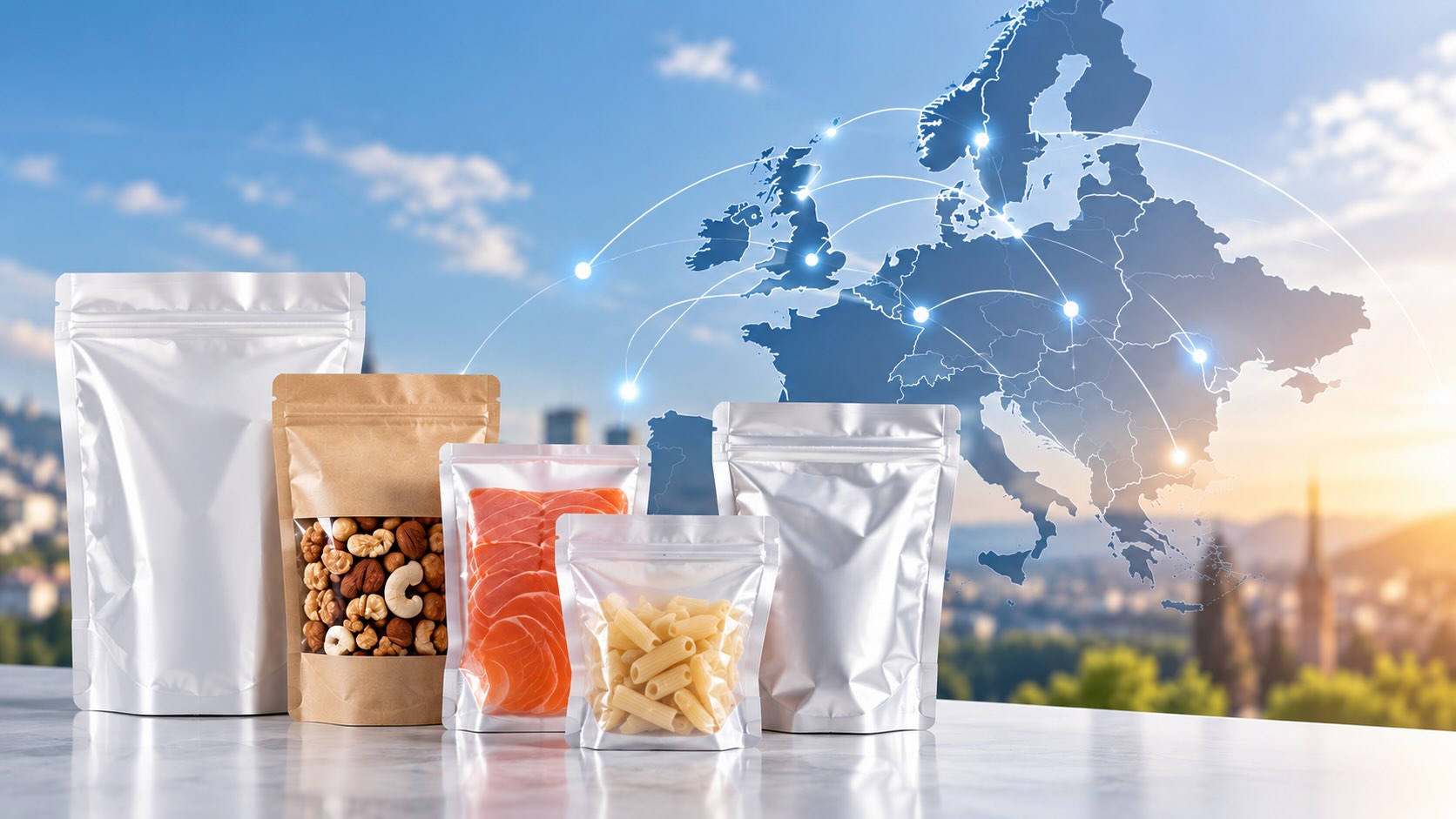
The flexible packaging market in Europe is undergoing significant change. Alongside market growth, new requirements for recyclability, ecodesign, raw materials, and European regulations are shaping how packaging is designed and manufactured.
At the same time, new materials, technologies, and processes are emerging to improve packaging performance without compromising product protection and preservation. Looking ahead to 2027, manufacturers and brands will need to continue adapting their packaging to a landscape shaped by the PPWR, ecodesign, recyclability and material optimisation. We explore how the European market is evolving and the trends that will shape future developments.
What is flexible packaging?
Flexible packaging is a type of packaging made from materials such as plastic films, paper or aluminium that can easily adapt to the shape of the product. Common examples include bags, pouches, films, wraps and flexible lidding.
One advantage is the ability to tailor the structure to each application, combining the protection, barrier, strength, and sealing properties required by the product. Its lightweight nature can also help optimise raw material use, storage, and transport.
This is why its composition is designed with the product, the packaging process, and the required shelf life in mind.
How is the flexible packaging market growing in Europe?
Europe is a mature market, so forecasts point towards steady growth rather than significant increases. However, this growth is accompanied by a major shift in the types of packaging being demanded.
According to MarketsandMarkets, the European flexible packaging market reached approximately $54.429 billion in 2025 and could reach $56.854 billion in 2027 and $60.711 billion in 2030, with a compound annual growth rate (CAGR) of around 2.2%.
Source: MarketsandMarkets, Europe Flexible Packaging Market.
Flexible packaging market growth data
These figures indicate moderate but sustained growth in the flexible packaging market over the coming years.
What is driving demand for flexible packaging?
The growth of flexible packaging is largely driven by its ability to protect products while using resources efficiently. It also offers advantages throughout packaging, transport and storage:
- It weighs less than many rigid packaging formats.
- Barrier properties can be tailored to the requirements of each product.
- It takes up less space during transport and storage.
- It can be adapted to different packaging processes and formats.
- It can help keep products in good condition for longer.
In food applications, reducing material should not mean reducing protection. The objective is to optimise the amount of material used while maintaining the barrier, sealing and mechanical properties required to protect the product throughout its shelf life.
Innovation in flexible packaging materials
Innovation in flexible packaging materials is enabling lighter structures, improved performance, and designs better prepared for new European requirements.
The challenge is to achieve these advances without compromising important factors such as barrier properties, sealing, strength or product preservation.
Material trends for 2027
Developments gaining ground in Europe include:
- PE and PP structures designed to facilitate recycling.
- New coatings and barrier technologies.
- Thinner films that maintain their functionality.
- The incorporation of recycled plastic where its use is permitted.
- Paper-based structures for suitable applications.
- Bio-based or compostable materials for specific uses.
Rather than focusing on a single material, development is increasingly centred on designing structures around the requirements of each application. Mono-material PE and PP solutions, downgauging and barrier technologies compatible with recycling are therefore becoming key areas of innovation.
What are brands looking for in flexible packaging materials today?
When selecting packaging, brands need to balance functionality, recyclability, and industrial feasibility. Factors considered include:
- Product preservation and shelf life.
- Food safety.
- Performance on packaging lines.
- Strength during transport and storage.
- Print quality.
- Compliance with European regulations.
No single structure suits every product. A food product requiring a high barrier does not have the same requirements as a dry product or one with a short shelf life, so each development must address specific needs.
Sustainable flexible packaging: what does the European market require today?
The move towards more sustainable flexible packaging is not simply about reducing material. The challenge is to optimise each structure while maintaining the performance the product requires: barrier properties, sealing, strength, machinability and shelf life.
With the PPWR already applicable, design decisions are increasingly shaped by requirements for minimisation, recyclability, and recycled content. Although some of the main obligations will be phased in up to 2030 and beyond, adapting and validating packaging structures takes time.
The challenge of recycling flexible packaging in Europe
Flexible packaging recycling in Europe depends on both packaging design and the systems available to collect, sort, and process it. CEFLEX works in this area by establishing criteria to improve circularity and facilitate the recovery of flexible packaging.
Why is flexible packaging still difficult to recycle?
Several factors can make the process more complex:
- Combinations of incompatible polymers or materials.
- The presence of certain barriers, inks, adhesives or coatings.
- Residues from the packaged product.
- Difficulties in identifying and separating certain formats.
- Differences between national collection systems.
Recyclability must therefore be assessed by considering the complete packaging structure.
What progress is being made in recycling infrastructure?
Mechanical recycling processes are available in Europe for certain PE and PP flexible packaging streams, although collection, sorting and processing capacity continues to evolve and varies between countries.
Processes designed to handle more complex structures are also advancing. The aim is to recover materials of sufficient quality to be used as raw materials in new applications.
Digitalisation of flexible packaging
The digitalisation of flexible packaging is creating new possibilities in both production and packaging communication. Digital printing enables shorter production runs, customised designs and greater flexibility when managing product references or design changes.
This is particularly useful for brands with extensive product ranges, frequent launches, limited editions or customisation requirements.
Traceability, QR codes and smart labelling
Digitalisation also makes it possible to incorporate tools into packaging that connect the physical product with online information. QR codes and other identification systems can be used to:
- Check product traceability.
- Access usage or storage instructions.
- Provide additional information about composition.
- Provide recycling instructions.
- Verify product authenticity.
- Access additional brand content.
In this way, packaging can provide additional information without requiring all of it to be included within the printed area.
What to expect from flexible packaging in Europe in the coming years
Looking towards 2027, flexible packaging in Europe will increasingly be shaped by the need to combine product protection, recyclability, resource optimisation, regulatory compliance and industrial efficiency.
We will see structures increasingly tailored to each application’s requirements, improved barrier technologies compatible with recycling, and greater integration of digital tools.
The future will not necessarily depend on finding a single material that can replace all others. The key will be better packaging design that uses the resources required for each application without compromising protection, shelf life, safety or industrial efficiency.
How SP Group can help you adapt your flexible packaging to the European market
Adapting packaging to new European requirements involves assessing its design, performance during the packaging process, product protection and recyclability.
At SP Group, we support manufacturers and brands in developing flexible packaging tailored to each application, combining technical expertise, ecodesign and innovation. We assess each project to optimise the packaging structure and make progress towards compliance with PPWR requirements.
Do you need to adapt your packaging to the new requirements of the European market? Contact SP Group, and we will work with you to identify the most suitable solution for your product and packaging process.