


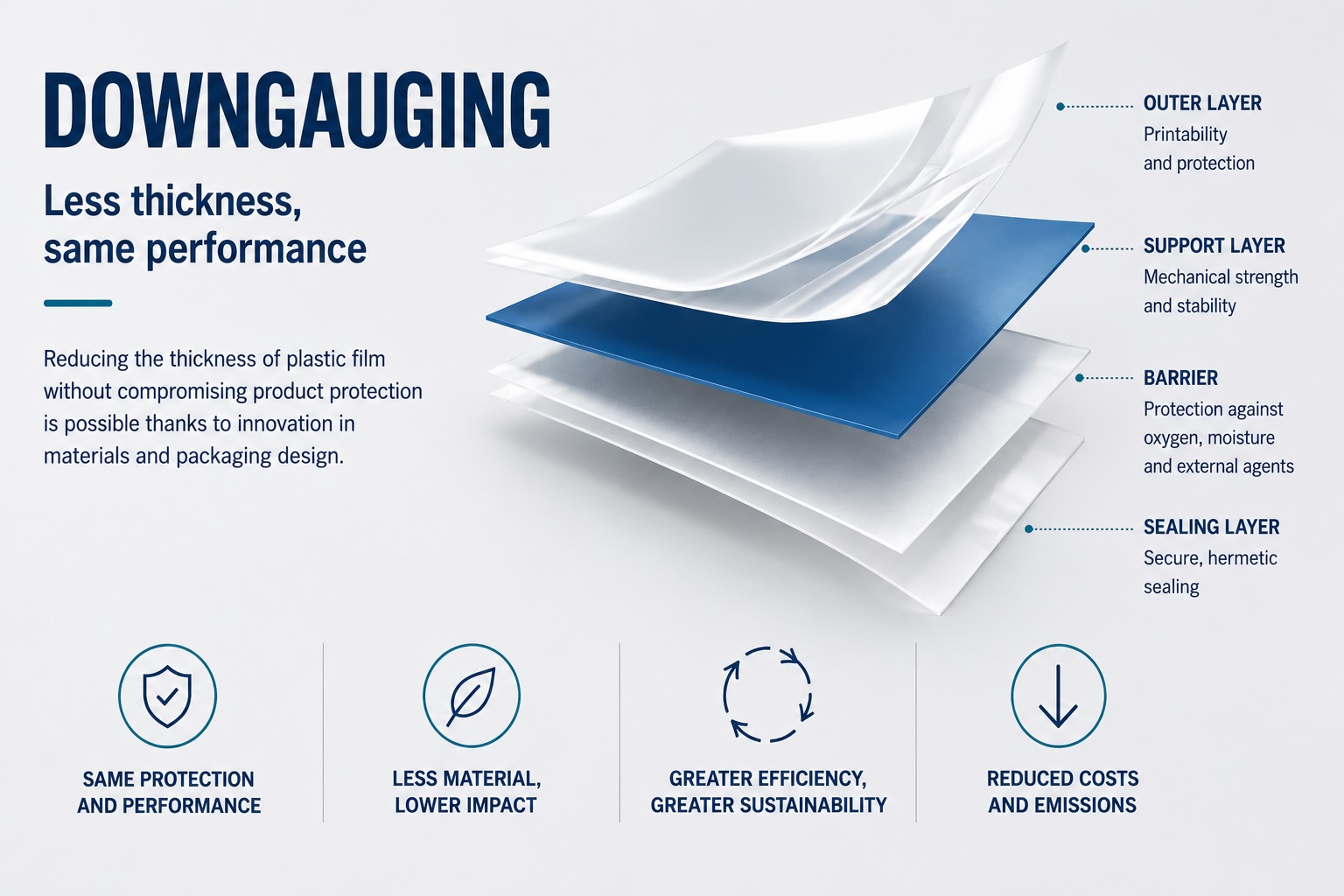
Reducing the amount of plastic used in packaging without affecting its strength or the protection it provides is one of the biggest challenges facing the packaging industry today. In this context, downgauging has become a key strategy for developing more efficient and sustainable packaging solutions. It involves reducing the thickness of plastic film while maintaining the performance required for each application. Achieving this, however, involves far more than simply using less material. It requires redesigning the packaging, selecting the most suitable materials and optimizing every stage of the development process. In this article, SG Pack explains what downgauging is, its main benefits and why it will play a crucial role in helping businesses comply with the new Packaging and Packaging Waste Regulation (PPWR).
What is downgauging and why will it be essential under the PPWR?
Downgauging is the process of reducing the thickness of plastic film so that less material is used without compromising the packaging’s quality, strength or ability to protect the product. In other words, the goal is not simply to produce thinner packaging, but to ensure it delivers the same level of performance while using only the amount of plastic that is truly necessary.
This approach will become even more important as the Packaging and Packaging Waste Regulation (PPWR) comes into force. The regulation promotes the development of packaging that uses less material, is more resource-efficient and is designed to improve recyclability. As a result, companies that optimize their packaging through strategies such as downgauging will be better positioned to meet evolving regulatory requirements while supporting the transition towards more sustainable packaging.
Reducing plastic film thickness without compromising performance
Successfully reducing the thickness of plastic film without affecting its performance requires a combination of engineering expertise, advanced material development and a thorough understanding of the packaging process. Every product, packaging line and industry has different requirements, which means there is no one-size-fits-all solution. Effective downgauging depends on developing packaging that is specifically tailored to each application.
Material reduction must ensure that the packaging continues to provide the required level of protection throughout storage, transport and the product’s entire shelf life. For this reason, a detailed technical assessment is essential before modifying any packaging structure.
Which properties must be maintained when reducing material?
When implementing downgauging strategies, reducing material thickness must never compromise packaging performance. To ensure the packaging continues to fulfill its function, it is essential to preserve properties such as:
- Mechanical strength, to withstand handling, transport and storage.
- Seal integrity, ensuring secure and reliable sealing performance.
- Puncture and tear resistance, preventing damage during handling and use.
- Barrier properties against oxygen, moisture and other external agents, where required to preserve product quality.
- Rigidity or flexibility, depending on the specific application.
- Stability during the packaging process, ensuring efficient operation on production lines.
Innovation in materials and packaging design
The development of new formulations, high-performance resins, and optimized material structures makes it possible to manufacture lighter films without sacrificing performance. At the same time, packaging design is increasingly based on efficiency principles, ensuring that each material layer performs a specific function and contributes real value to the overall structure.
These innovations also support the development of mono-material solutions and packaging structures designed to improve recyclability, helping manufacturers align with the circular economy principles promoted by European legislation.
Benefits of downgauging for manufacturers and brands
Implementing downgauging strategies enables manufacturers to reduce material consumption without compromising packaging performance. When approached through eco-design and supported by careful material selection, the benefits extend across the entire value chain, from manufacturing to distribution.
Less plastic and a lower environmental impact
Reducing the thickness of plastic film means using less raw material and generating less waste. As long as the packaging continues to provide the required level of product protection, this can lead to lower manufacturing costs and a reduced carbon footprint.
Improved logistics and greater operational efficiency
Lighter packaging reduces transport weight, improves the efficiency of logistics operations and can help lower the energy consumption associated with storage and distribution. It can also simplify certain handling processes without affecting the functionality of the packaging.
Greater competitiveness and regulatory readiness
Downgauging enables companies to meet the growing demand for more sustainable packaging solutions while preparing for regulations such as the PPWR. This provides a competitive advantage for brands looking to differentiate themselves through more efficient and responsible packaging.
Driving eco-design and innovation
Reducing material usage requires packaging to be re-engineered by optimizing structures, formulations and manufacturing processes. The result is flexible packaging solutions that make better use of resources, maintain high performance and support the development of packaging better suited to a circular economy.
The role of packaging design in material reduction
The success of downgauging largely depends on packaging design. Reducing material thickness requires careful analysis to ensure the packaging continues to deliver the same level of performance. Key considerations include:
- Packaging geometry, ensuring structural strength and functionality.
- Real-world operating conditions, including transport, storage and the packaging process.
- Material selection, choosing structures that allow thickness reduction without compromising performance.
- Life cycle assessment, balancing sustainability, product protection and operational efficiency.
- Packaging recyclability, prioritizing solutions that are compatible with existing recycling systems and circular economy principles.
Optimized packaging design enables safe material reductions, improved packaging efficiency, and progress towards more sustainable solutions without sacrificing technical performance.
Technical challenges of downgauging flexible films
Although downgauging offers significant advantages, its implementation requires a high level of technical expertise. Successfully reducing the thickness of flexible films without affecting performance involves carefully controlling factors such as:
- Mechanical strength, to prevent damage during handling and transportation.
- Seal quality, ensuring secure and reliable package integrity.
- Material stability, allowing the packaging to perform consistently on production lines.
- Performance validation through testing, confirming that the packaging maintains its properties under real storage, transport and usage conditions.
- Application-specific adaptation, as packaging requirements differ considerably between food products, industrial goods and fast-moving consumer goods.
For this reason, every downgauging project must be assessed individually. Only by taking a tailored approach is it possible to reduce material usage while maintaining product protection and packaging performance.
How to prepare packaging to meet PPWR requirements
Complying with the PPWR means designing more efficient packaging from the very beginning of the development process. To achieve this, companies should focus on:
- Reducing plastic film thickness wherever it is technically feasible.
- Designing packaging that is optimized for recycling.
- Simplifying packaging structures and making more efficient use of materials.
- Developing solutions that support the principles of the circular economy.
Taking these steps now will help businesses comply with upcoming regulations, improve the sustainability of their packaging, and remain competitive in a rapidly evolving market.
How SP Group can help you develop more efficient flexible packaging solutions
At SP Group, we work closely with manufacturers and brand owners to evaluate each project individually and identify the most suitable solution based on the product’s requirements, the packaging process and each company’s sustainability objectives.
Our team develops flexible packaging solutions designed to use less material, improve recyclability and help businesses prepare for the new PPWR requirements.
Looking to optimize your packaging and prepare for the future? SP Group combines expertise in eco-design and flexible packaging to develop solutions that are more efficient, more sustainable, and tailored to your business needs. Contact us to discover the best packaging solution for your products.