

Understanding the different printing technologies is essential to knowing why certain methods are recommended for specific types of packaging while others are not. In this article, we explain what flexographic printing is, how the flexographic printing process works and how it is used in the packaging industry.
Product promotion and marketing rely heavily on packaging that enhances a brand’s visual identity. This is where flexographic printing stands out, thanks to its versatility and its ability to deliver high-quality results across a wide range of materials.
Of course, flexography is not the only packaging printing technology available. At SP Group, we also offer other printing systems, such as gravure printing and digital printing.
Choosing the right printing method depends on the specific characteristics of each project, its marketing objectives and, naturally, the packaging requirements of the product itself. Selecting the most appropriate technology can also help optimise production costs, lead times and packaging performance throughout the product’s life cycle.
What is flexographic printing?
Flexographic printing is a direct printing process that uses flexible relief plates to transfer ink onto a substrate. It is particularly valued for its ability to print on non-porous materials while delivering fast, efficient production. Here’s how it works.
Today, flexographic printing is one of the most widely used technologies for flexible packaging. Advances in printing plates, inks and modern press technology have significantly improved print resolution, colour consistency and production efficiency.
What is flexographic printing used for?
Flexographic printing transfers ink onto the printing substrate using a rotating roller system.
Unlike other printing technologies, it relies on printing plates as its core component. Traditionally, these plates were made from rubber, while today they are mainly manufactured from photopolymer, which is where the name flexography originates.
Preparing the flexible printing plate
- The plate material is photosensitive.
- It is exposed to ultraviolet (UV) light.
- A high-contrast image negative is used during the process.
- UV exposure creates the raised image areas on the surface of the plate.
Once the plate has been prepared, the inking process begins. Ink is applied to the plate while pressure is exerted on the printing substrate, allowing the ink to transfer only from the raised areas.
How the inking system works
- The raised areas receive an even layer of ink.
- The recessed areas remain ink-free.
- Excess ink is removed during the process.
Once inked, the plate continues rotating until it comes into gentle contact with the substrate. The image is transferred, and the printed material dries quickly.
When multiple colours are required, the process remains the same. Separate printing plates are used for each colour, making it possible to reproduce an extensive colour range and efficiently produce packaging with complex, pre-designed graphics.
Characteristics of flexographic inks
As with any printing technology, ink plays a fundamental role in understanding both flexographic printing and its importance in packaging design.
Flexographic printing uses several types of ink, although alcohol-based inks are the most common. They are valued for their low viscosity and rapid drying time. This is one of flexography’s greatest advantages, as it enables high-volume print runs to be completed efficiently.
These inks are also liquid, which further enhances their fast-drying properties.
Another key characteristic is that flexographic inks are generally transparent rather than opaque. This allows colours to be overprinted without completely covering one another, creating greater flexibility for more creative packaging designs.
Ink formulations are also evolving to support the development of recyclable packaging and mono-material structures. The objective is to maintain excellent print performance while helping packaging manufacturers respond to increasingly demanding sustainability and recyclability requirements.
Other types of inks used in flexographic printing
- Solvent-based inks.
- UV-curable inks, which are primarily used in non-food applications. The food industry generally avoids UV inks because of the potential risk of ink migration. Their main advantage is instant curing when exposed to UV light, enabling exceptionally fast and efficient production.
Another benefit of flexographic printing is its compatibility with both single-colour and multi-colour printing, as well as with a variety of finishing options, including:
- Varnishes.
- Foil stamping.
- Plastic lamination.
The choice of ink depends on both the substrate and the desired design. For example, white ink is commonly used when printing on transparent materials, while photographic-quality graphics may require up to eight colours to achieve the desired result.
Which products are printed using flexography?
Flexographic printing stands out for its wide range of applications. Thanks to its ability to print on a variety of substrates, it is a technology that is present in everyday life, even though it often goes unnoticed by the end consumer.
Packaging printed using flexography
Packaging is, without doubt, the primary application for flexographic printing. It is widely used for:
- Food packaging
- Plastic and paper bags
- Flexible films
- Self-adhesive labels
Flexography makes it possible to produce attractive, durable and safe packaging for products that come into direct contact with food or cosmetics, while complying with all relevant industry regulations.
At SP Group, flexographic printing is used across a wide range of applications in sectors such as food, pharmaceutical, pet food, cosmetics and industrial packaging. Each project requires the right combination of materials, inks and finishes to meet its technical, visual and regulatory requirements.
Other common applications of flexographic printing
Beyond packaging, flexographic printing is also used for products such as:
- Gift wrap
- Envelopes and industrial sacks
- Napkins and toilet paper
- Industrial and logistics labels
This broad range of applications demonstrates why flexography remains one of the most widely used printing technologies in the industrial sector.
Advantages of flexographic printing
Flexographic printing is widely recognised in the flexible packaging industry for its efficiency, versatility and excellent balance between print quality, cost-effectiveness and sustainability. These are some of its main advantages.
High-speed printing
Flexography enables long production runs to be completed in a relatively short time, making it an ideal solution for high-volume manufacturing. The fast drying properties of flexographic inks help streamline production and shorten lead times.
Suitable for a wide range of materials
Another major advantage is its versatility. Flexography can print on a wide variety of substrates, including plastic films, paper and cardboard, making it suitable for many different packaging formats and applications.
Supporting more sustainable packaging
Modern flexographic printing can also support the development of more sustainable packaging solutions. Advances in printing technology, automation and process control make it possible to print efficiently on recyclable mono-material structures while reducing material waste, setup losses and unnecessary production consumption.
High-quality printing in up to eight colours
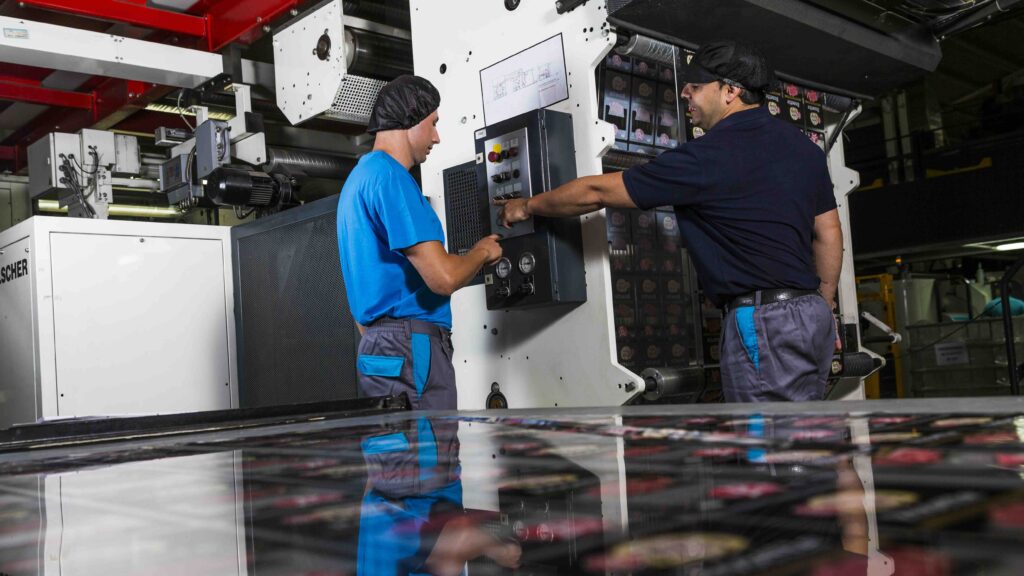
At SP Group, we combine state-of-the-art flexographic technology with extensive technical expertise to achieve excellent print quality, colour consistency and production efficiency. Our presses are capable of printing in up to eight colours while maintaining outstanding registration accuracy, even on demanding production runs.
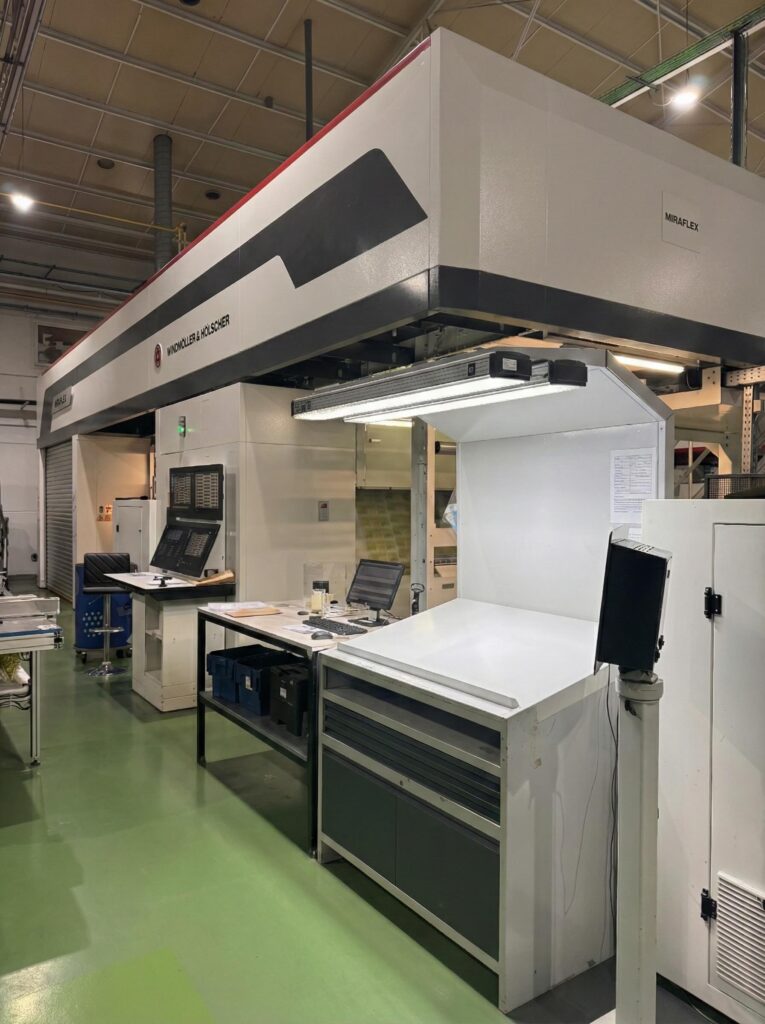
Our flexographic equipment includes two NOVOFLEX II presses and one MIRAFLEX II press from Windmöller & Hölscher, a global leader in CI flexographic printing technology. This allows us to produce high-quality designs with precisely the colour combinations required for each project.
The NOVOFLEX II presses are renowned for their outstanding registration accuracy, excellent stability at high production speeds and consistently high print quality during long production runs. Their robust and versatile design enables them to process a wide range of material structures while ensuring maximum production efficiency and consistent results.
The MIRAFLEX II, the latest addition to our technology portfolio, represents a significant step forward in automation, operator ergonomics and energy efficiency. Alongside exceptional print quality and reduced changeover times, it also offers inline coating capabilities, enabling us to add value to packaging during the printing process itself, reducing production times and enhancing the final finish of the product.
This combination of advanced technologies enables us to meet the requirements of different markets, packaging formats and technical specifications while delivering maximum quality, flexibility and competitiveness for every project.
Flexography vs gravure printing: what’s the difference?
Although flexographic printing and gravure printing are both used for high-volume printing, they differ significantly in the way they operate and the applications they are best suited for.
Flexographic printing
- Uses flexible relief printing plates.
- Requires a lower initial investment.
- Allows quick design changes and greater production flexibility.
- Offers faster setup and shorter changeover times.
Gravure printing
- Uses engraved cylinders with microscopic cells that hold the ink.
- Is more cost-effective for extremely long print runs.
- Delivers highly consistent print quality throughout continuous production.
The choice between the two technologies depends on the type of project, the production volume and the specific requirements of the packaging.
How to get the most out of flexographic printing
To fully benefit from flexographic printing, every stage of the process must be carefully optimised.
Key factors to consider
- A graphic design adapted to the characteristics of the flexographic printing process.
- Careful material selection based on the type of packaging.
- Proper preparation of the printing plates.
- Precise press setup to ensure consistent print quality.
- Choosing inks that are compatible with both the substrate and the desired finish.
Working with a specialist in flexographic printing also helps optimise production processes, improve manufacturing efficiency and ensure consistently high-quality results across every print run.
SP Group: packaging solutions beyond printing
At SP Group, we combine extensive expertise in flexographic packaging solutions with innovation, sustainability and the highest quality standards. This enables us to make flexographic printing a key technology for developing efficient packaging solutions tailored to the demands of today’s market.
Now that you know how flexographic printing works, it’s worth remembering that, although its advantages are undeniable and it is an excellent choice for many applications, it is not the only printing technology available. That’s why we provide tailored advice for every project. Contact us, and we’ll assess your packaging requirements to recommend the printing solution that best suits your products.