


Is recyclable packaging made from recycled plastic? Although both concepts are linked to the circular economy, they do not mean the same thing. Packaging can be recyclable without containing any recycled plastic, while packaging made with recycled material may not itself be recyclable.
Understanding the difference between recycled and recyclable is essential when selecting materials and developing suitable packaging solutions.
In this article, we explain what each term means, the different types of recycled plastic available, and the requirements established by European regulations for their use.
Recyclable packaging and recycled packaging: what does each term mean?
The difference lies in what each term describes:
- Recyclable packaging: packaging that, thanks to its design and composition, can be collected, sorted, and recycled using suitable, available processes. For example, packaging made from virgin plastic that can be converted into raw material for manufacturing other products.
- Recycled packaging: packaging that incorporates materials recovered from waste during its manufacture. For example, packaging containing recycled plastic that may be difficult to recycle again because of its composition.
Packaging can therefore be made from recycled materials, recyclable, both or neither.
The following table summarises the main differences:
Ecodesign aims to use resources more efficiently without compromising product protection, to facilitate recycling, and to incorporate recovered raw materials wherever feasible.
Recycled plastic and recycled content in packaging
Recycled content is the amount of recovered material used to manufacture new packaging. For example, virgin plastic can be combined with plastic obtained from recycled waste.
However, incorporating recycled plastic does not guarantee that the packaging can be recycled again or that it has a lower environmental impact. It is also necessary to check that the packaging retains the strength, barrier properties, and protection required by the product.
PCR or post-industrial recycled plastic: what counts as recycled content?
There are two main types, depending on their origin:
- PCR (post-consumer recycled material): comes from products that have already been used and discarded, such as bottles collected for recycling.
- PIR (pre-consumer or post-industrial recycled material): comes from waste generated during manufacturing processes and recovered to produce new materials, provided it meets the criteria for classification as recycled content.
Production scrap that is reused directly within the same manufacturing process is not considered recycled content.
Mass balance is another approach used to track the input of recycled raw materials and allocate an equivalent quantity to specific products. This does not necessarily mean that each pack physically contains that proportion of recycled material.
This is why recycled plastic traceability is essential for substantiating its origin and any recycled-content claims.
Recycled plastic in contact with food
Not all recycled plastic can be used in food-contact applications. Regulation (EU) 2022/1616 establishes requirements for its safe manufacture and use, alongside other European legislation governing food-contact materials.
Before incorporating recycled plastic, the following must be checked:
- Origin: where the recovered plastic comes from.
- Treatment: the recycling and decontamination process, where applicable.
- Safety: compliance with food-contact requirements.
- Protection: retention of the necessary barrier, strength and sealing properties.
For example, manufacturing PET sheets containing recycled content requires careful control of the process and material characteristics. rPET can be used in certain food applications when it meets the relevant technical and legal requirements.
Regulations on recycled content in packaging
Regulation (EU) 2025/40, known as the PPWR, introduces new requirements for packaging placed on the European Union market, including:
- Recycled content: establishes minimum post-consumer recycled plastic (PCR) content targets for certain packaging categories from 2030, or later dates specified in the Regulation, with some exceptions.
- Recyclability: introduces progressive requirements to ensure packaging is designed to be collected, sorted and recycled effectively after use.
Packaging design must therefore consider product protection, recyclability and the use of recycled raw materials, wherever technically and legally feasible.
Recycled content certification and traceability
Verifying recycled content is essential to ensure transparency and support environmental claims. European standard EN 15343 provides a framework for the traceability and assessment of recycled plastics and recycled content.
Certification and traceability systems help manufacturers:
- Verify origin: identify where recycled materials come from.
- Ensure traceability: track recycled materials throughout the recycling and production processes.
- Confirm recycled content: document the proportion of recycled material used in packaging.
However, certified recycled content does not necessarily mean that packaging is recyclable. Recycled content certification verifies the use of recycled materials, while recyclability assessments examine whether packaging can be effectively recycled.
A package can therefore contain certified recycled plastic without being recyclable, or be recyclable without containing any recycled material.
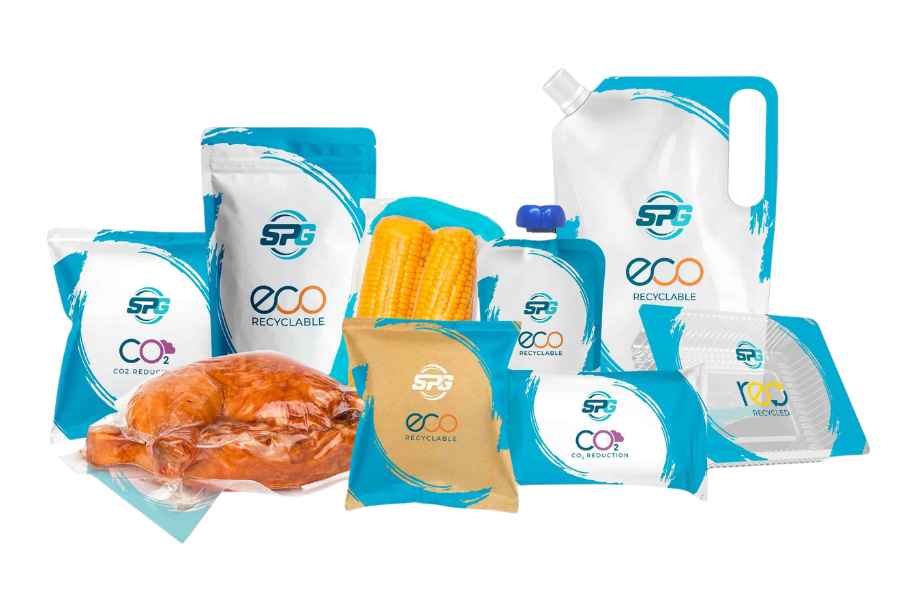
How SP Group develops recycled and recyclable packaging
At SP Group, we develop flexible packaging solutions that combine product protection, industrial efficiency and ecodesign. We assess the requirements of each application and focus on:
- Material selection: choosing the most suitable structures according to the product and packaging process.
- Resource optimization: adjusting material thickness without compromising packaging protection or quality.
- Recyclability: developing mono-material structures and offering selected solutions whose recyclability has been certified by Cyclos-HTP.
- Recycled content: incorporating recovered raw materials wherever technically and legally feasible.
We also support manufacturers and brands in developing packaging that meets the new PPWR requirements.
Would you like to improve your existing packaging or develop a new solution? Contact SP Group, and we will explore the most suitable options for your product.
Frequently asked questions about recycled and recyclable packaging.
Can packaging made from recycled plastic be recycled again?
Yes, provided its design and composition allow it to be recycled. This depends on the materials used, the layers that make up the packaging, and the availability of suitable collection and recycling systems.
Is packaging containing recycled content more expensive?
Not necessarily. Its price depends on the type of recycled plastic, its availability, quality, and manufacturing process. It is therefore important to assess the overall cost of the packaging rather than just the raw material price.
Can I label packaging as “recyclable” without certification?
Private certification is not always mandatory, but the claim must be supported by technical evidence and comply with applicable regulations. Using the term “recyclable” without being able to substantiate it may constitute greenwashing.